Project Status
Estimated Completion
Late 2026Contact
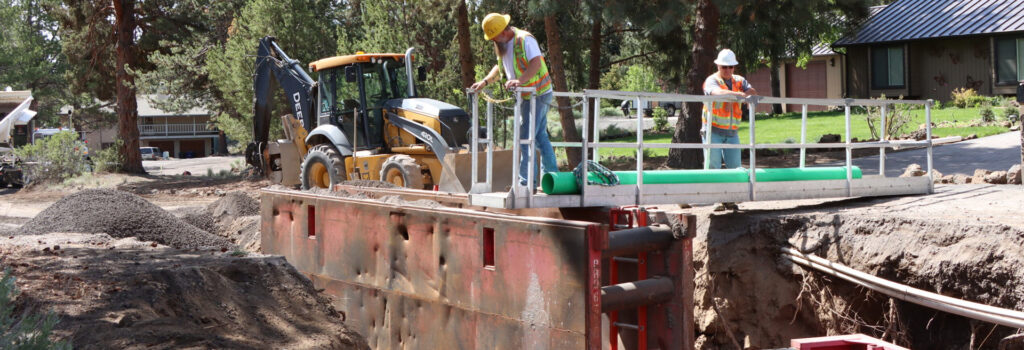
King Hezekiah Fargo Septic to Sewer Project
A Septic to Sewer Conversion Program Project.
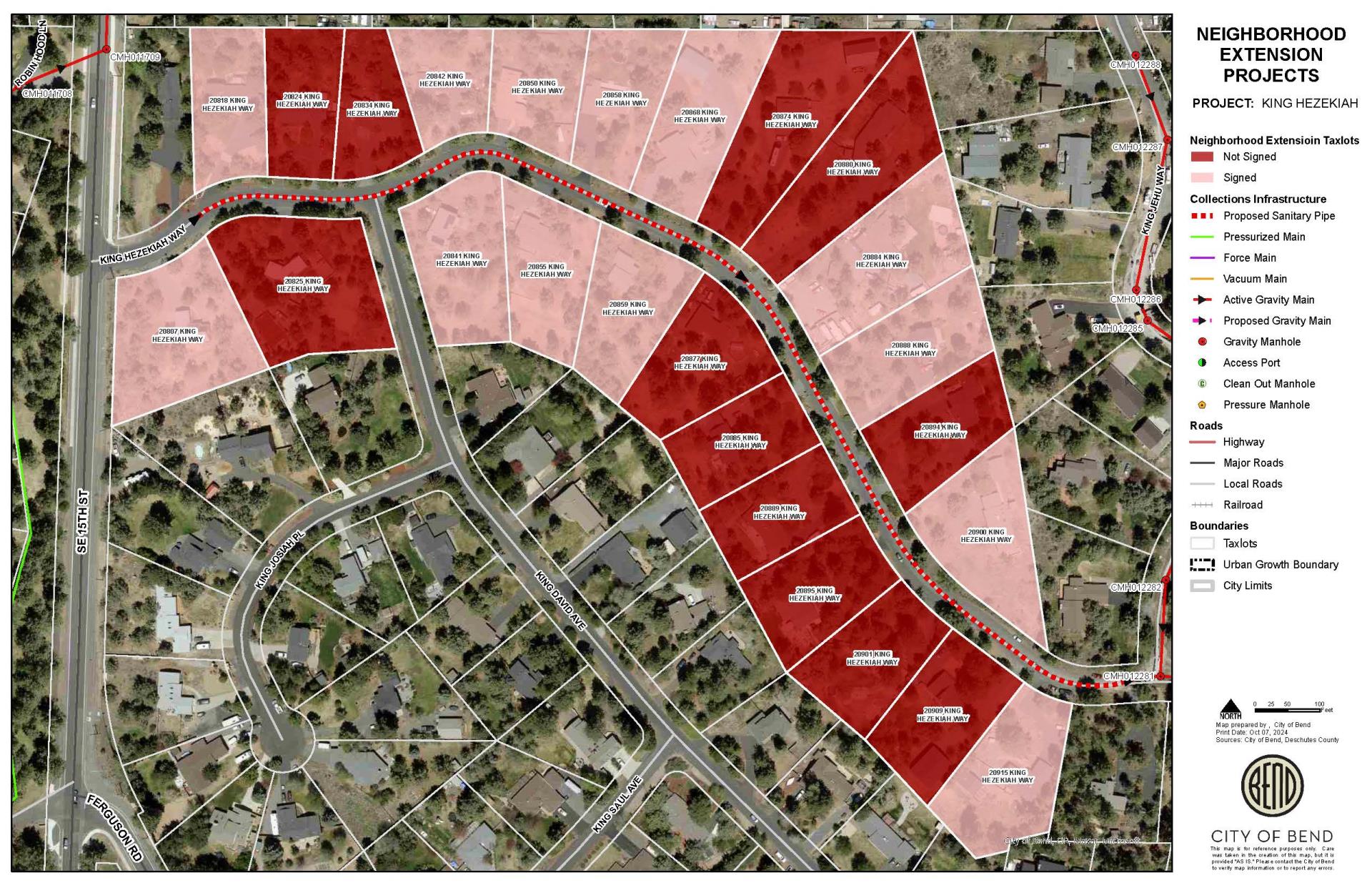
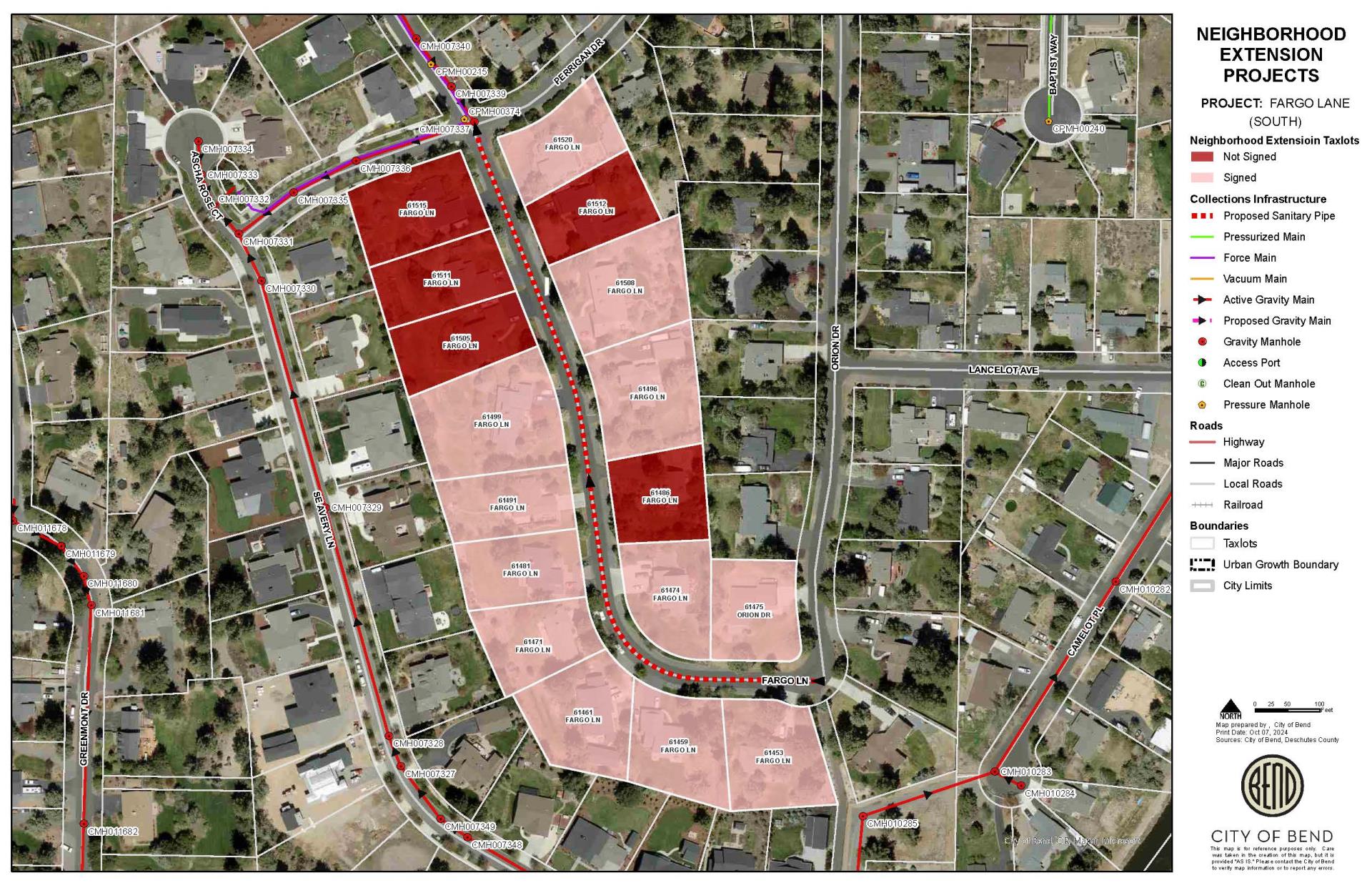
Residents applied to the City of Bend Septic to Sewer Conversion Program to install public sewer in their neighborhoods. The following application areas were approved for design and construction as the King Hezekiah and Fargo Sewer Project (1SN09):
- King Hezekiah
- Fargo Lane #2 (South)
Gravity and pressure sewer mains (as applicable to the project area) will be constructed in each of the application areas. Sewer laterals will be installed to every tax lot in the area to allow approximately 42 properties to decommission their septic systems and connect to the public sewer system. Construction will be completed in phases. Franchise utility relocation work may take place winter 2025 through spring 2026 (residents will be notified in advance of any relocation work). The City of Bend Septic to Sewer portion of construction will take place throughout 2026*.
Location
King Hezekiah
Fargo Lane #2 (South)
Schedule
- Committee Selection of the Project – October 2024
- Project Design – 2024-2025*
- Franchise Utility Relocation Work – winter 2025 through spring 2026 (natural gas, power, cable, etc.)
- Fargo Lane Anticipated Construction – early April 2026 through July 2026*
- King Hezekiah Anticipated Construction – late May 2026 through October 2026*
*Schedule dates are estimates and subject to change.
Background
Residents in the project areas applied to the City of Bend Septic to Sewer Conversion Program to install public sewer in their neighborhoods. On October 28, 2024, the City of Bend Community Building Subcommittee approved the design and construction of the sewer.
Funding


This project is funded by the Clean Water State Revolving Fund (CWSRF).
Public Meetings
- April 02, 2026 – Informational Pre-construction Meeting and Presentation: City of Bend hosted event to discuss the typical construction process associated with septic to sewer projects.
Download the Meeting Presentation
King Hezekiah and Fargo
Sign up to receive email updates for this project.
Frequently Asked Questions
The program serves public health, proactively protects water quality, and allows for economic development and urban development opportunities for properties limited by septic system capacity. City sewer provides property owners with reliable waste management that reduces the risk of negative environmental impacts.
You will not be required to connect to City sewer unless any of the following occur:
- A sewer main is installed adjacent to your property frontage and your septic system needs a repair permit or fails. The Deschutes County Environmental Soils Division can help with this determination.
- You apply for a development approval that increases the capacity requirements of the septic system. For example, adding an accessory dwelling unit, partitioning your property, and/or adding plumbing fixtures would increase the tank’s capacity requirements. Consult with Deschutes County Environmental Soils Division and City of Bend Community Development Department if you would like to expand your use of the property.
- If you signed an application for a Neighborhood Extension Project (NEP) and were chosen for funding, you will be required to connect within two years from when the City sends you a Notice of Operational Completion (NOC). Property owners along the Desert Woods and Neighborhood Extension Project and the Southeast Interceptor should refer to the Septic to Sewer COVID-19 Relief Program for specific connection timing requirements. The selected application is binding and runs with the land.
A committee including 1-3 City Councilors, the City Engineer, the Engineering, Infrastructure and Planning Director, and the City Manager, or their designees, will review submitted applications in light of the available funds and evaluation factors. The committee will select one or more neighborhood sewer extension projects for funding and construction to proceed pursuant to applicable City processes. The criteria for evaluation includes the following:
- Cost of the sewer extension project, including design;
- Total number of homes or properties to be connected to the public sewer system from the project;
- Whether other City construction projects are planned for the street identified in the application;
- The percentage of property owners who would be served by the neighborhood sewer extension project who have joined or signed onto the application;
- The age of existing septic systems that would be replaced by the proposed neighborhood sewer extension project and evidence of failing septic systems;
- Other factors established by the City Manager.
Council has indicated its support of approximately $3.5 million for the program each year. This amount can be increased or decreased in the future as it is subject to Council budget approval. The funds will come from an increase in wastewater rates to all citywide ratepayers. The $3.5 million per year covers a small portion of the total costs of converting properties on septic system throughout the city limits to the City’s sewer infrastructure. Each year, use of the $3.5 million will be allocated to Neighborhood Extension Projects based on criteria established during an application process. It is anticipated that Neighborhood Extension Projects will be in various neighborhoods throughout the City for properties still on septic systems or may be in neighborhoods in vicinity of the City’s capital improvement projects.
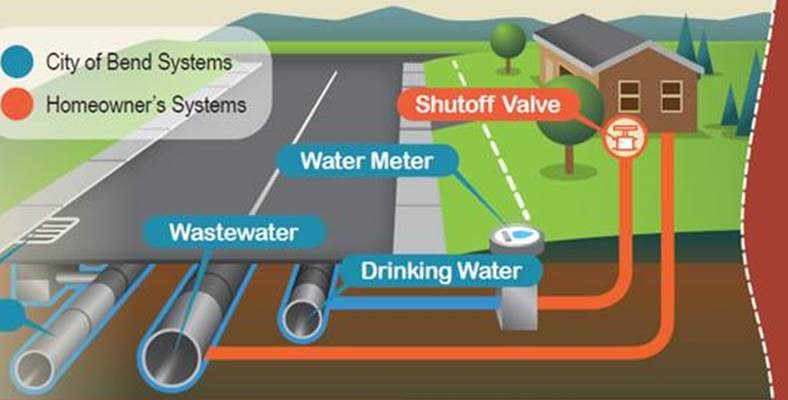
The graphic below helps to illustrate the program, and what is paid for, as part of the program. The City (ratepayers) pays for the cost of the sewer main in the road right of way (in blue). The property owners are responsible for the portion of the sewer lateral (also known as a ‘stub out’- in orange) which includes work on private property to connect to the sewer main. The property owner is charged a Connection Fee to pay for a portion of the costs of the sewer laterals, Systems Development Charges (SDCs), all permit fees, and all costs associated with decommissioning their septic system. All planning and development applications are also subject to a 4% long range planning surcharge.
Deschutes County Community Development Department issues septic system abandonment permits via their online portal. Typically, a septic system must be pumped by a licensed pumper, and then the tank is required to be removed, filled in place, or crushed and buried. Drainfields can typically be left intact, but they should not be excavated for a year after the last use. Distribution boxes should be pumped out by a licensed pumper and removed or filled in. Sand mounds can be left in place, but if removed, they should not be excavated for a year after the last use. Refer to Deschutes County for specific rules, regulations, and permit & inspection costs. The Deschutes County Environmental Soils Division can be reached at (541) 388-6519; Relay Users dial 7-1-1.
When a sewer main is installed and becomes active, property owners who received a stub-out from the project will receive a Notice of Operational Completion (NOC) in the mail. The NOC is notification that sewer is legally available to the property. Property owners who connect to sewer within two years of the date of the Notice of Operational Completion will receive a 50% discount on the Connection Fee. Property owners along the Desert Woods and Neighborhood Extension Project and the Southeast Interceptor should refer to the Septic to Sewer COVID-19 Relief Program for specific connection timing requirements.
No, the City requires gravity sewer mains and stub-outs where possible; however, pressure sewer mains or services are sometimes required in areas due to topography constraints. In some cases, the public sewer may be a gravity system; however, a private property owner may be required to own and maintain a private onsite grinder pump to pump sewage uphill to the public sewer system.
A Temporary Construction Access Agreement (TCAA) is a legal contract between a property owner and another party, often a construction company, that specifies the terms and conditions for accessing the owner’s property for construction work. The primary purpose of such an agreement is to protect the interests of both parties by clearly defining their respective rights and responsibilities during the construction process.
Below are links to two TCAA templates for reference as examples only:
An Infrastructure Transfer Agreement (ITA) is a coexisting agreement that accompanies a Temporary Construction Access Agreement (TCAA), which transfers ownership of the City-installed infrastructure to the private property owner at the time of project completion. Once transferred, the private property owner is solely responsible for the maintenance and repair of the infrastructure.
Below are links to two ITA templates for reference as examples only:
Please follow the provided Permit Application Process for Deschutes County septic tank abandonment permits and City of Bend plumbing permits for a septic-to-sewer conversion.