Houselessness Solutions
The City utilizes a comprehensive set of strategies to address the growing and complex challenges of houselessness in Bend and the region.

Working with a network of agencies and community partners, the City of Bend has responded to the houselessness crisis by leveraging state and federal funds to increase access and availability of emergency shelter, bolster social services, and support the production of transitional, affordable, and middle housing.
The City’s multifaceted approach includes the purchase of two motels and another site for shelter, developing and funding the operation of low and high barrier shelter beds, and supporting outreach through Safe Parking.
Additionally, the City has also reduced barriers to developing affordable housing and siting shelter and implemented a camping code to address camping in the City rights-of-way.
I want to Know More About…
Houselessness in Bend
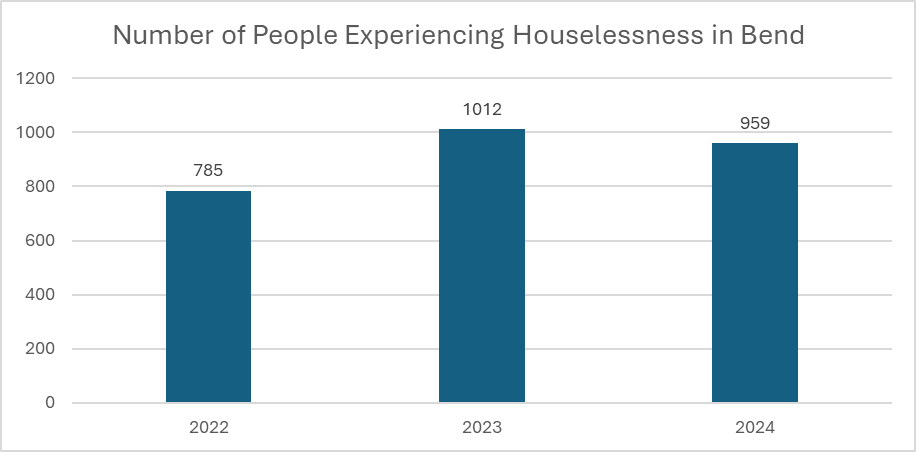
Each year in January, the Homeless Leadership Coalition conducts the Point-in-Time (PIT) Count, collecting information about people experiencing homelessness across Deschutes, Jefferson, and Crook counties and the Confederated Tribes of Warm Springs.
The 2024 Point-in-Time count identified 959 people experiencing houselessness in Bend, 55% of whom are surviving unsheltered. This represents a 5% decrease in the number of people experiencing houselessness in Bend and a decline in people experiencing houselessness who are unsheltered.
In recent years, the City has leveraged state, local, and federal dollars to expand shelter capacity, including the development of 236 additional shelter beds. The City also provides funding for services and supports the development of affordable and middle housing.
Years of underdevelopment in the United States has caused a significant housing shortage. In Bend, development is needed on every level of the housing continuum from market rate home ownership opportunities to affordable housing. Without more housing, our most vulnerable community members will continue to experience houselessness.
In tight market conditions where housing shortages exist, risk factors can lead an individual losing their housing. Risk factors include poverty, disability, addiction, time spent in foster care, or lack of supportive relationships. When combined with a triggering event, such as loss of job, health crisis or emergency, family or roommate conflict, or domestic violence, it can cause an individual to become houseless.
Full findings from the Point in Time Count are available on the Homeless Leadership Coalition website.
Common Misconceptions About Houselessness
The majority of our houseless neighbors have lived in the area for years. According to the 2024 PIT Count, 62% of people experiencing houselessness in Deschutes County have lived here for 5 years or longer.
Many people experiencing houselessness are employed and working toward more stable housing opportunities. However, in Central Oregon, they are often met with high housing costs and many rental units require large deposits. Market rent in Bend is approximately $1,686*. The Department of Housing and Urban Development finds that anyone paying more than 30% of their income to housing costs is considered “cost burdened” and anyone paying more than 50% of their income to housing costs is “severely cost burdened.” To avoid being cost burdened, a single individual making minimum wage and working full time would need housing less than $740 per month.
*CoStar. Q1 2024
Addiction is a complex disease and is often accompanied by its own set of misconceptions. Although unchecked addiction can be a triggering event for someone experiencing houselessness, it is often accompanied by other risk factors or events.
The 2023 PIT count showed that only 8% of people experiencing houselessness in Central Oregon identified having a disabling substance abuse disorder.