Wildfire Preparedness
Help keep people, homes and neighborhoods in our community safe by planning ahead and being prepared for emergencies like wildfire.
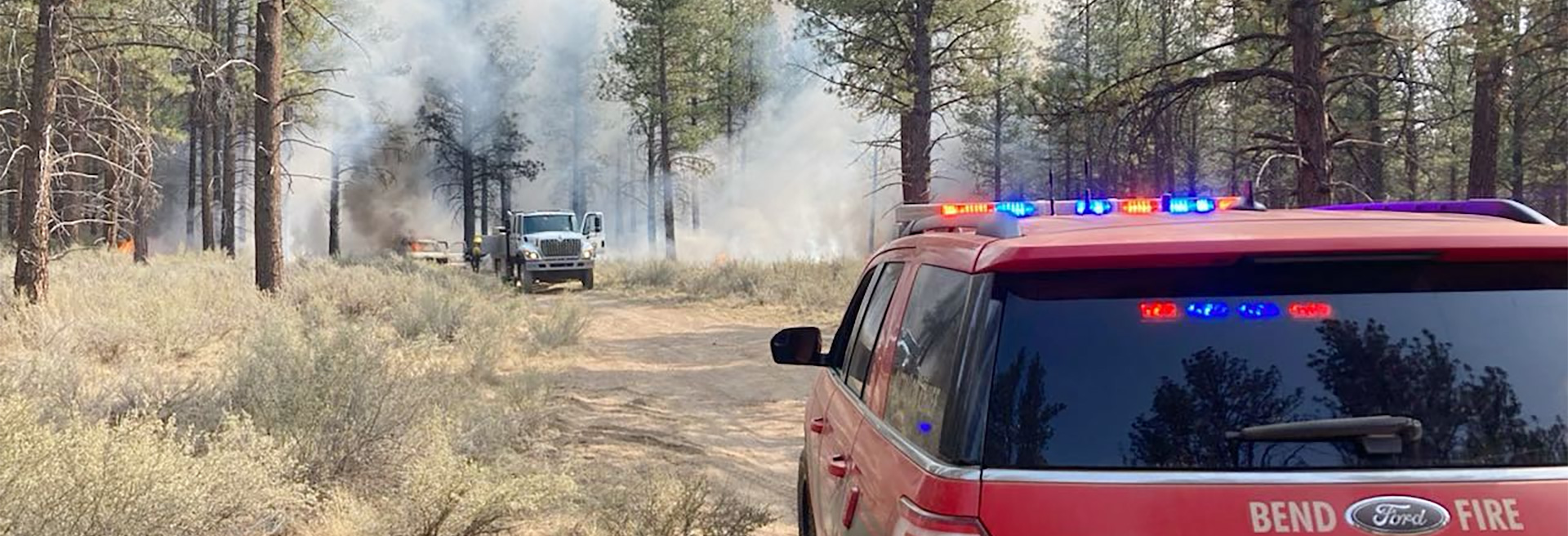
Making sure that Bend is prepared for the danger of wildfire is a community effort that each of us plays an important role in. Wildfire safety starts before a fire begins through preparing our homes and properties and being ready and informed on when and how to evacuate. As you are thinking about how to prepare for emergencies like wildfire, consider these questions:
- Are you able to be alerted of disasters like wildfire impacting your community? Staying informed through emergency alerts helps you to know when it’s time to evacuate you and your loved ones.
- What do you need to be ready to leave at a moment’s notice? What happens if you get an evacuation notice while you are not home? Having a plan for what you want to bring with you during an evacuation, and preparing a basic emergency kit, can help you evacuate quickly ahead of a fast-moving wildfire.
- Are your home and property protected from wildfire? There are actions that you can take to make it less likely that they will be lost in a wildfire like clearing dead and dry plants away from your foundation.
Being prepared, acting early, and working together as a community can make a big difference during wildfire season.
Be Ready Before and During Fire Season
Taking proactive steps before wildfire season begins can make all the difference in protecting your family, home, and community—here are some key actions you can take to be ready before and during fire season:
- Register for Emergency Notifications.
- Create a list of the “5-Ps” – People, Pets, Pills, Photos, and important Papers.
- Prepare a 72-Hour Kit.
- Know alternate ways out of your neighborhood.
- Know the evacuation plans for your family members in school, assisted living and childcare facilities.
- Designate an out-of-area contact who can relay information about your status to others.
- Plan out how you will transport your pets.
- Keep your vehicle’s fuel tank at least half full
- Create defensible space around your home. Visit Own Your Zone for more information.
Own Your Zone
Wildfire is a natural part of Oregon’s forests, and it continues to pose a threat to our communities. The “Own Your Zone: First Five Feet” campaign encourages residents to take simple steps to create defensible space around their homes—starting within the first five feet of the foundation. Whether you live in a city or a rural area, these actions can help protect not just your home, but your entire neighborhood.
Wildfire Risk Home Assessments
Bend Fire & Rescue can help you learn how to protect your home from wildfires. We offer free assessments to check your property and give advice on how to make it safer.
Learn more about requesting a Wildfire Risk Home Assessment.
Don’t want to wait? You can do your own check! Use this easy home assessment checklist from the Oregon State Fire Marshal’s Office.
Reporting and Complaints
Who should you call when you have concerns about wildfire risk?
Wildfire is a real threat here in Central Oregon. The City of Bend Code Enforcement team and Bend Fire & Rescue both address wildfire mitigation in Bend, and Deschutes County addresses mitigation outside city limits.
Bend Fire & Rescue
Bend Fire & Rescue hosts the Fire Marshal and Deputy Fire Marshal of Wildfire Preparedness, as well as an entire Prevention Division dedicated to helping the community prepare for and prevent wildfire.
Wildfire Mitigation Topics Covered by Bend Fire & Rescue:
- Fire Code Compliance and Oregon State Fire Marshal Best Practices
- Property Assessments, Creating Defensible Space and Home Hardening techniques
- Building Firewise Communities
- Debris Burning Regulations
Request a home assessment or community prevention event. or by calling (541) 322-6300.
City of Bend Code Enforcement
The City of Bend Code Enforcement team mission includes protecting the safety of the City’s residents and visitors from wildfire. They ensure compliance with the City’s land use, environmental and building codes.
Wildfire Mitigation Complaints Covered by Code Enforcement:
- Excess Flammable Vegetation
- Lack of Defensible Space
- Need for Reduction of Ladder Fuels
- Property Assessments, City Code Compliance
Note – Code Enforcement has been conducting property assessments for over 12 years, both proactively for those wanting to verify compliance with City Code, and retroactively following complaints. Reach out if you want an assessment!
Submit a code complaint that you would like to be investigated related to these issues:
Deschutes County Code Enforcement
Deschutes County Code Enforcement does not have a specific code pertaining to flammable vegetation like the city does. For Deschutes County specific code complaints and compliance:
Frequently Asked Questions
The City of Bend is one of many organizations that prepare for, and respond to emergencies when they take place. From our firefighters and law enforcement officers responding to emergencies daily, to long-range development planning and routine discussions about how we manage our City’s critical infrastructure – emergency preparedness is top of mind for your City decision-makers.
County, City, and public safety agencies routinely work together to ensure a safe, effective, and coordinated fire response. The Deschutes County Sheriff’s Office takes the lead in coordinating partner organizations including fire, law enforcement, public works, public health, and non-governmental organizations such as Red Cross to respond to various hazards and needs during emergencies and ensure clear direction for the public.
Agencies work together to clearly communicate evacuation routes, road closures and detours, safe meeting areas and resources for community members who have been displaced as information is available.
Don’t wait to be told to evacuate! Leave as early as possible, before you’re told to evacuate. Do not linger once evacuation orders have been given. Promptly leaving your home and neighborhood clears roads for firefighters to get equipment in place to fight the fire.
Always have sturdy shoes and a flashlight near your bed, ready for sudden night evacuations, and have a “Go Bag,” or evacuation kit, ready and include items such as:
- A three-day supply of non-perishable food and three gallons of water per person.
- A map with at least two evacuation routes.
- Necessary prescriptions or medications.
- A change of clothes and extra eyeglasses/contact lenses.
- Extra car keys, credit cards, cash, or traveler’s checks.
- A first aid kit and sanitation supplies.
- A flashlight and battery-powered radio with extra batteries (NOAA weather radio is a good option).
- Copies of important documents (birth certificates, passports, etc.).
- Pet food and water.
If time allows, consider adding:
- Valuables that are easy to carry.
- Family photos and irreplaceable items
- Personal computer data on hard drives.
- Chargers for cell phones and laptops.
Stay aware of the latest news and updates from your local fire department and first responders. Follow professional agencies on social media, sign-up for emergency alerts and do what you can to stay connected when there isn’t an emergency so that you are ready when one does happen.
Prepare your family, home, and pets to evacuate and place your “Go Bag” and other valuables in your vehicle. Other actions to consider if time allows:
- Move patio or deck furniture, cushions, door mats and potted plants in combustible containers either indoors or as far away from the home, shed and garage as possible.
- Block open wooden fence gates to create breaks.
- Close and protect your home’s openings, including attic and basement doors and vents, windows, garage doors and pet doors to prevent embers from penetrating your home.
- Connect garden hoses and fill any pools, hot tubs, garbage cans, tubs, buckets, or other large containers with water. Firefighters have been known to use the hoses to put out fires on rooftops.
A few simple actions have the potential to not only save your home but your neighbors, and possibly, your entire neighborhood:
- Perform a home assessment. Creating wildfire resilient communities starts with you and your home. The Oregon State Fire Marshal has a great home check list that you can use to assess your property for wildfire risk. Find this list at oregondefensiblespace.org.
- Own Your Zone. Once you’ve assessed your property – own your zone! The Own Your Zone: First Five Feet campaign focuses on raising awareness about the simple actions every homeowner can take to create defensible space around their home. Creating a defensible space means removing combustible fuels, such as yard debris, from your property to help reduce wildfire risk. Whether you are in the middle of a city or in a more rural neighborhood, there are actions you can take that will harden your home against wildfire. Learn more at bendoregon.gov/own-your-zone.
- Get your neighborhood Firewise recognized. The national Firewise USA® recognition program provides a collaborative framework to help neighbors in a geographic area get organized, find direction, and take action to increase the ignition resistance of their homes and community and to reduce wildfire risks at the local level. Learn more at firewise.org.
- Attend Project Wildfire meetings. The Project Wildfire Steering Committee is formed by a Deschutes County Ordinance to specifically address the risks of wildland fire in our community. These monthly meetings are in person or virtually on the third Tuesday of the month at 8 a.m. Find more information at projectwildfire.org.
- Attend a Wildfire Home Protection Strategies Workshop. Multiple local and State agencies centered around wildfire education host workshops throughout the year to teach community members how to protect their homes against wildfire. Let them know you are interested so that they can plan one in your area.
The decision to evacuate is made jointly by responding agencies including Bend Fire & Rescue and law enforcement. In the event of an evacuation, Deschutes County 9-1-1 would issue evacuation orders. Stay informed by signing up for Deschutes Alerts to receive emergency notifications via phone, text, email and more. Sign-up at deschutesalerts.org.
Because each emergency is different, you cannot plan exactly which route will be available in an emergency. This is why it is recommended to identify a couple of routes out of your neighborhood before an emergency occurs. The roads people use to evacuate during an emergency are the roads people use every day if they are still safe.
Deschutes County has worked with the City of Bend to identify Critical Transportation Routes and have incorporated these into Community Wildfire protection plans that are located on their website deschutes.org/emergency. You can view a map of Critical Transportation Routes under the “evacuation” tab to help you plan your route.
Sometimes first responders will designate routes due to the danger presented by a hazard, and the City of Bend would help as we can with signage and traffic management, but often we ask folks to identify their own routes out of their neighborhood in the event they need to evacuate because it takes time to mobilize resources. We also recommend leaving as early as possible when emergencies arise, and not waiting for an evacuation alert, to help reduce traffic leaving the area at once.
When evacuating, people may experience several factors that they need to problem solve. This could be the loss of power causing traffic signals to not work, or accidents that close a previously available route. Be aware that the unexpected will likely occur and being flexible and calm will help you to navigate these issues as they arise.
Because evacuations often result in normal traffic patterns being severely disrupted, keeping our Arterials and Collectors free-flowing will be a focus for emergency responders during an evacuation.
Current street design requirements focus on minimum widths for emergency response vehicles to get to an emergency. Having appropriately sized streets for emergency vehicles, designing gridded neighborhoods that have multiple exit and having requirements for connected roads (as opposed to cul-de-sacs) are some of the ways Bend’s roads are prepared for emergencies.
For people who live within city limits, the City of Bend is just one provider of water. Other providers include Avion Water and Roats Water System. Having the redundancy of multiple water service providers in our area is a huge benefit in a large-scale emergency.
The City of Bend water infrastructure includes 15 water reservoirs, six booster pump stations and over 440 miles of pipe that feed into 5,000 hydrants throughout the city.
While there is a lot that the City can’t control with natural disasters, we do have emergency plans and redundancies in place that will help us last as long as possible in the event of a large-scale emergency.
Some of the ways we prepare or respond to an emergency:
- Water Services staff are always on hand to monitor the City of Bend’s water infrastructure and keep in close communication with first responders during an emergency. Not only can our systems be managed on the ground, there is also technology in place that allow us to control infrastructure from afar if a facility can’t be accessed.
- Reservoirs are dispersed throughout the water distribution area and placed at differing elevations. This so that the reservoirs administer appropriate flow rates to our hydrants in town, and it also create redundancies in our water system by having our water sources spread out. Should one of our reservoirs be threatened by fire or begin to run low, staff can advise responders on water access immediately.
- Reservoirs are filled automatically using groundwater wells, limiting the need for human intervention. The groundwater wells pump groundwater into the reservoir and then water leaves the reservoir and enters the distribution system as demand occurs. As the water level in the reservoir drops to a specific level the groundwater wells turn back on and refill the reservoir.
- Back-up diesel generators are maintained and ready to be positioned at specific groundwater wells to keep them running in the event of power loss. Several wastewater lift stations also have generators built into the design to keep wastewater flowing the right direction if a loss of power occurs.
- If there was a wildfire that threatened water resources, the City of Bend would follow our Water Curtailment Plan. This plan helps us to prioritize the emergency at hand by shutting down water use that is not directly related to responding to the incident, meaning we would immediately and temporarily restrict all non-essential water use like landscape irrigation.
Emergency planning is ongoing. In addition to what’s mentioned above, the City routinely meets to discuss emergency plans and utilizes real world events, like what is currently happening in Pacific Palisades and Altadena, to improve our own emergency response plans to mitigate the impact of a natural disaster.
Municipal water systems are required to meet specific operating criteria. This means that water providers like Avion and Roates must follow the same requirements the City does when it comes to meeting required water and hydrant flow rates and determining hydrant types and placement.
Reservoirs are engineered to deliver a specific water flow for a period of time that equates to typical structure fire in our water service area – not a wildfire. It is typical for these reservoirs to hold 3-5 million gallons at a time, and they are placed at very specific elevations designed to deliver flow rates of 2,500 or 3,500 gallons per minute depending on the location of Bend’s hydrants (residential hydrants will have a different flow rate than those in commercial areas).
New developments have stricter hydrant location and fire flow standards than neighborhoods built over 30 years ago. Our current standards for developments require hydrants spaced at a maximum of 400’ apart, and that they be located in spots that are easily accessible and protected for first responders. As far as hydrant functionality, there is only one type of hydrant allowed that is in conformance and functions with the types of hoses and apparatuses that Bend Fire & Rescue uses.
Regardless of the hydrant owner and location, Fire crews have mapping that tells them where the nearest hydrants are in the city during an emergency response.
Water is only one way to fight wildfire. Wildfires in the wildland-urban interface, or the area between rural forest land and a municipality, are combated using a variety of firefighting techniques.
While structure fires rely heavily on hydrant systems, the firefighting techniques for a wildland fire are much different (think aerial attack; fire lines cut into the ground with bulldozers and wildland crews).
Many wildland and some structural firefighting apparatus like Water Tenders have the ability to pull water from natural sources as well as from hydrants – Bend has an abundant supply of natural water sources that could be used in the event of a wildfire.
If a fire event grew beyond the water system’s capability, there would be communication between Water Services staff and responding agencies regarding our system limitations, and a transition plan would be put in place.
Bend Fire & Rescue is staffed to respond offensively to mitigate a single large structure fire. If there are multiple structures on fire simultaneously, Bend Fire would respond using defensive tactics (preventing the spread of fire to other structures), mobilizing all department resources, as well as all available regional mutual aid resources that are coordinated through Deschutes County 9-1-1. This coordinated response system means that regional agencies will be called to respond when additional resources are needed for an emergency, so our neighboring fire departments from Redmond, Sisters, La Pine and beyond would be dispatched to the fires. If all local and regional agencies have been asked to respond and there is still a need for more resources, we would rely on the Oregon State Fire Marshal to determine the level of the emergency and whether it requires a formal declaration, which would then mobilize additional units across the state and – if determined necessary – other states.
Unfortunately, when there is a large-scale emergency, the potential people being taken advantage of is greater. Community members should stay diligent and aware that there may be scams and misinformation circulating. Verify what is being shared on social media with trusted and vetted resources like government sites (agencies with .gov, .org and .edu are typically trustworthy sources).
See what the American Red Cross says about scams and rumors during an emergency and recovery effort.