Winter Information
Winter visits Bend between November and April.
Keeping the runway open at the Bend Municipal Airport when there is snow on the ground is our goal. To do this requires a high level of coordination between pilots, the FBO, tenants and our snow removal contractors. Please check NOTAMS. Here is the link to AWOS. Please help us by keeping informed and up to date and doing your part to ensure coordination.
Priority Areas
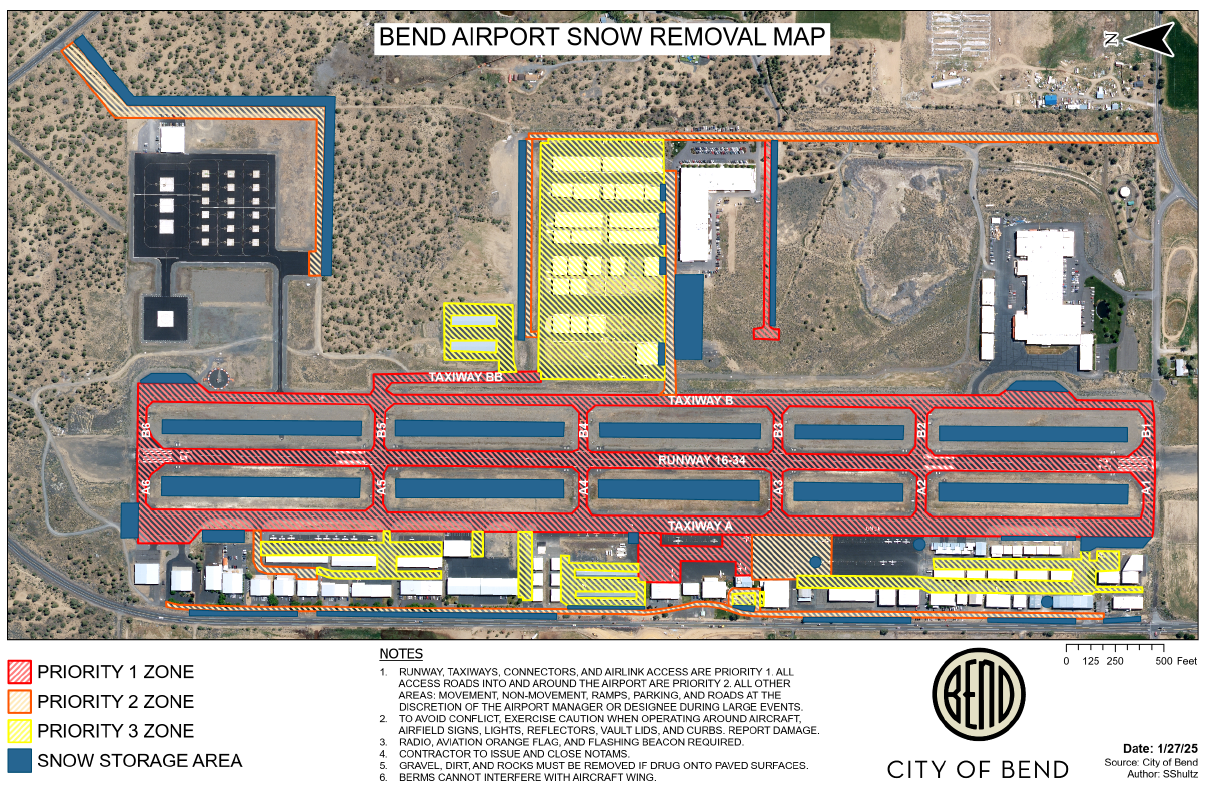
The City’s first priority is to remove the snow from the runway along with access to Air Ambulance and taxiways followed by access to the FBO (red). All other areas, movement, non-movement, ramps, parking and roads will be cleared at the discretion of the Airport Manager or designee during large events. Tenants can help us by only storing snow in designated snow storage areas. These areas are designated in blue on all maps.
Download a copy of the Bend airport snow removal map
Snow Operations – Frequently Asked Questions
It takes 4-5 hours to clear the parallel taxiways and runway. The rest of the airport can take two eight hour days, depending on conditions. Knife River currently takes care of the taxiways and runways and are radio equipped (123.0). We are so happy that the Knife River drivers are veteran airport snow operators.
Normally we will call out the snow plows when the snow accumulation reaches 2.0 inches. Very wet heavy snow at 1.5 inches and lighter amounts at 2.0 inches. As you know from shoveling at your house or snow blowing your driveway, snow accumulation depends on the snow storm and overall weather system. So decisions are made for each storm considering a variety of factors.
The City’s first priority is to remove the snow from the runway along with access to Air Ambulance (red). This is followed by access to the FBO and all access roads (orange). Taxiways will be cleared next (yellow). Finally, we’ll address snow on the taxilanes and hangar accesses (green). Tenants can help us by only storing snow in designated snow storage areas. These areas are designated in blue on all maps.
Once it is decided to plow, a NOTAM will be issued closing the runway and parallel taxiways until the plow operators deem them safe for aircraft use.
ATC request that we provide 60 minutes advance notice of runway closures to allow enroute IFR aircraft an opportunity to land. As noted in the narrative above the weather is not predictable enough to know that a 5 minute freezing rain will turn the runway into an ice rink. Delaying any safety related closure will put all pilots at risk. If you are planning an IFR flight into the Bend Airport be prepared for short notice closures and have alternate plans available. We will attempt to allow 60 minutes before issuing the closure NOTAMs but cannot jeopardize safety to do so.
Check with FSS before heading out for a flight but don’t be surprised if the runway is closed on your way out. Why? Snow storm depths and accumulation rates cannot be predicted with any accuracy and NOTAMS are not issued for closures until after the decisions is made to plow and sometimes just before plows take to the runway to minimize the closure periods.
It’s really the snow depth and or consistency of the snow fall that triggers the closure decision, not the plowing. The length of the closure is determined by how long it takes to plow.
There are 32 miles of plowing, if you use an eight foot swipe, which is about all you can get when a longer blade is angled. It can take 4-5 hours to clear the parallel taxiways and runway. The rest of the airport can take two eight-hour days, depending on conditions.
No.
During snow removal operations, the Airport Manager is most likely to be on the airfield, not in the office answering the telephone. Providing hangar access is a PRIORTY 4 as shown in green on the Airport Snow Removal Map.
Of course you can. In many cases your lease will tell you that you are responsible for the asphalt areas directly outside of your hangar. Coordination is paramount during snow operations. There are designated snow storage areas throughout the airport. Please move the snow that is by your hangar to the nearest snow storage area.
All snow storage areas are designated in blue on the Airport Snow Removal maps.
Arriving at an airport to find it closed can be frustrating if you are planning on flying. If you are planning on landing it can become an emergency. Other facilities within your fuel range may also be impacted by the same storm that has closed your destination’s runways.
Pilots should consider all of the following:
Always check NOTAMS before every flight in accordance with FAR 91.3 and 91.103:
Sec. 91.3 — Responsibility and authority of the pilot in command.
(a) The pilot in command of an aircraft is directly responsible for, and is the final authority as to, the operation of that aircraft.
(b) In an in-flight emergency requiring immediate action, the pilot in command may deviate from any rule of this part to the extent required to meet that emergency.
(c) Each pilot in command who deviates from a rule under paragraph (b) of this section shall, upon the request of the Administrator, send a written report of that deviation to the Administrator.
Sec. 91.103 — Preflight action.
Each pilot in command shall, before beginning a flight, become familiar with all available information concerning that flight. This information must include—
(a) For a flight under IFR or a flight not in the vicinity of an airport, weather reports and forecasts, fuel requirements, alternatives available if the planned flight cannot be completed, and any known traffic delays of which the pilot in command has been advised by ATC;
(b) For any flight, runway lengths at airports of intended use, and the following takeoff and landing distance information:
(1) For civil aircraft for which an approved Airplane or Rotorcraft Flight Manual containing takeoff and landing distance data is required, the takeoff and landing distance data contained therein; and
(2) For civil aircraft other than those specified in paragraph (b)(1) of this section, other reliable information appropriate to the aircraft, relating to aircraft performance under expected values of airport elevation and runway slope, aircraft gross weight, and wind and temperature.