Frequently Asked Questions
Frequently Asked Questions
The Transportation and Mobility Department maintains 936 lane miles of public streets, including 165 lane miles of main arterials, 80 lane miles of collectors and 691 lane miles of local residential streets. Typically, plowing begins when snowfall accumulates 2 inches or more. Crews start by plowing the Priority 1 routes, or main arterials, working toward Priority 2 routes, for emergency vehicle access, also focusing on routes to the Hospital, government facilities, and schools (if class is in session). Residential streets are typically done last as Priority 3 routes. As a note, the City of Bend does not maintain alleys and will not remove snow from any alley. Please understand that every street cannot be cleared at the same time. Under ideal circumstances, we can predict fairly accurately when we will have streets in various sections of the City plowed. As weather conditions change, we often must alter our snow-fighting strategy in the midst of the snow control operations in order to control drifting snow, ice or other special problems. We cannot give you an estimate of when your street will be cleared due to storm intensity or ever-changing weather conditions.
Because of normal snow plowing operations, snow may be placed in your driveway unavoidably. Snowplows are angled to the right for plowing from the centerline of the street to the curb. For this reason, a certain amount of snow will be deposited in driveways as the snow unloads. Snow left in driveways or on sidewalks by the city while snow plowing, is the residents and owners responsibility to remove.
When plowing, snow may end up on the driveway you just shoveled. We apologize for the inconvenience this may causes. If your schedule permits, you may want to wait and clear your driveway after snowplows have passed through your street. If it’s a significant snowfall, the snowplow may return to make multiple passes. Streets are typically opened with one pass through so that streets can be made passable for drivers as soon as practical. Snowplows may return to open the street curb-to-curb. This is done to clear areas for on-street parking and to allow melting snow to drain into catch basins. We regret that you may find some of this snow on your recently shoveled driveway. There are 40,000+ driveways in the City limits. If the City used all of the snowplows and spent just 60 seconds per driveway, it would take several days to clean driveways alone.
Snow removal tip:
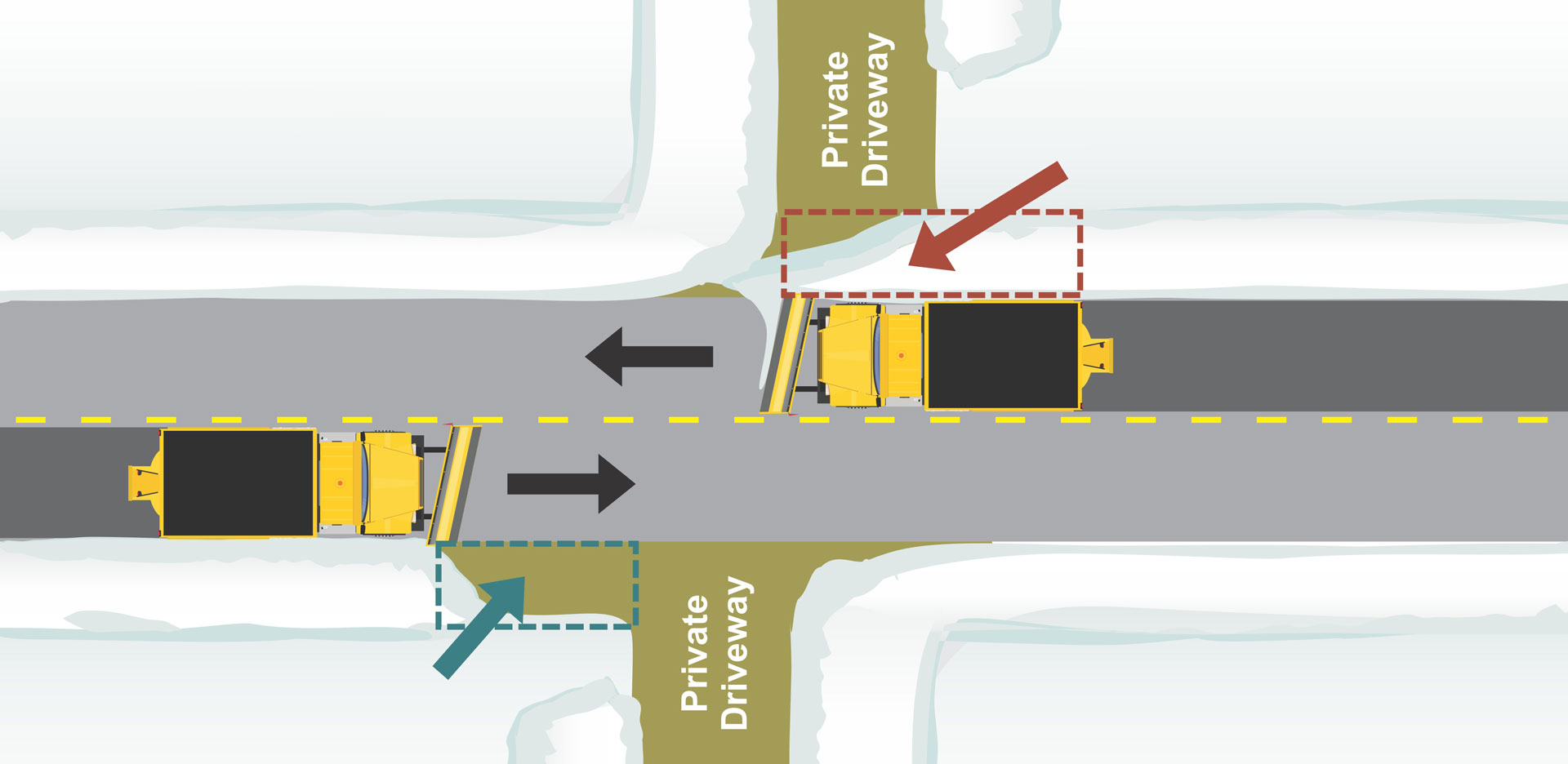
If your driveway is cleared before the street is plowed, clear an area to the right of your driveway (if you are facing the house, the oncoming side). When the plow comes by, the snow will dump onto this cleared area and diminish the amount of snow plowed onto your driveway approach. The more snow you clear from this area, the less will be deposited along the travel route. To minimize further problems, pile snow that has been shoveled from the driveway and cleared areas onto the DOWNSTREAM side of the driveway and behind the sidewalk. This prevents the snowplow from moving this snow back into your driveway or on the sidewalk. Snowplow operators do not come back to plow out any driveway entrance.
Some areas of the city have narrow public rights of way. These areas can be impacted more than wider areas because there is a need to clear as much snow out of the street as possible. When plowing, the snow may end up on the sidewalk you just shoveled. We apologize for the inconvenience this may causes. If your schedule permits, you may want to wait and clear your sidewalk after city snowplows have passed through your street. If it’s a significant snowfall, the snowplows may return to open the street curb-to-curb. Streets are typically opened with one pass through, so that streets can be made passable for drivers as soon as possible and to clear areas for on-street parking, where it’s permitted and to allow melting snow to drain into catch basins.
Snowplows are emergency vehicles, but typically do not exceed the posted speed limit. Snowplows are large, noisy pieces of equipment. It may appear at times that the snowplow operator is driving too fast for road conditions. Many times, the engine sound and noise of the plow scraping the pavement give the perception that the truck is flying down the street, when in actuality, they are moving at 15 to 25 miles per hour. The snowplows do move faster on open stretches of roadway to push snow farther off of the road to ensure there is sufficient space to stack the snow. Please remember – do not follow snowplows too closely and give them plenty of room.
Snow may not be pushed into or across the street from private property, per City of Bend Code 13.45.015 Surface Waters-Drainage. This also pertains to private streets, parking lots, driveways and sidewalks. A violation of this Code is a Class B Civil Infraction (ord. NS-2141, 2010).
Residents and owners are reminded to remove snow from sidewalks within 24 hours after the snowfall has stopped and 6 hours for commercial properties, per City of Bend Code 5.35.020 (Snow and Ice). If you have a fire hydrant in front of your property, it is your responsibility to remove snow accumulation from around the hydrant.
For more information, see Snow and Ice Removal.
If your mailbox is struck by a Contractor or City snowplow during snow control operations, please contact the City of Bend Transportation and Mobility Department at 541-323-5980 during normal business days (Monday thru Friday, 7 a.m. and 4 p.m.) Public Works staff will review the incident with you for details and direct you to the Supervisor or Contractor responsible. Non-standard mailboxes and enclosures placed in the public rights of way are at the owner’s risk and responsibility. Snow removal near mailboxes is the responsibility of the adjacent property owner. Mail service may be hindered by or stopped if access to the mailbox is not clear of snow.
Remember to not landscape with rocks, bricks, timbers, shrubs and other items in the right of way. Some residents may have irrigation in the right of way. This is done at the owner’s risk and responsibility. Keep any irrigation heads away from the edges of the curbs and sidewalks. Snowplows could cause damage or become damaged by landscaping materials in the right of way.
If it’s discovered that a snowplow damaged a curb and/or sidewalk, please report to the Transportation and Mobility Department at 541-323-5980.
The City of Bend Transportation and Mobility Department works closely with the Bend Police Department and Bend Fire Department. Anytime there is an emergency that requires snow control assistance, one of the plowing crews are pulled from their regular route to respond as quickly as possible.
Snowplow operators take pride in clearing the streets on their routes as quickly and thoroughly as possible. Driving a snowplow is demanding, tiring work. Common sense and good safety practices dictate that each driver should take a 30-minute break every four to six hours. It is dangerous, both for the snowplow driver and the public if a fatigued driver is behind the wheel. It’s in the best interest of the all concerned for drivers to take occasional breaks.
We wish we had enough snowplows and drivers to take care of every street right away, but our resources are limited. Therefore, we must adhere to a carefully laid out system for clearing the streets. To keep our snow control operations as effective and efficient as possible, snowplows deviate from their assigned routes as little as possible. Main arterial streets have first priority for snow plowing, followed by collector streets and then residential streets.
Unfortunately, staff cannot give you an estimate of when your street will be cleared of snow due to ever-changing weather conditions, emergency situations, traffic congestion (increased traffic could slow things down greatly) or available resources (City and/or Contractors). As weather conditions change, we often must alter our snow-fighting strategies in the midst of the snow control operations in order to control drifting snow, ice or other specific problems.
Snowplow operators follow assigned routes. If they were to spread sand continuously to their destination they would run out before completing their route. Sanding locations are concentrated on steep grades, stops, railroad crossings, roundabouts, curves and extreme conditions where necessary.