Housing Production Incentives and Resources
The City of Bend is committed to supporting the development of housing that reflects the diverse needs of its community members. Historically, efforts have prioritized deed-restricted affordable homes, meaning – housing that remains affordable over time, helping households build stability and thrive. By encouraging a broad mix of housing types, the goal is to create a community that’s inclusive, resilient, and full of opportunity.
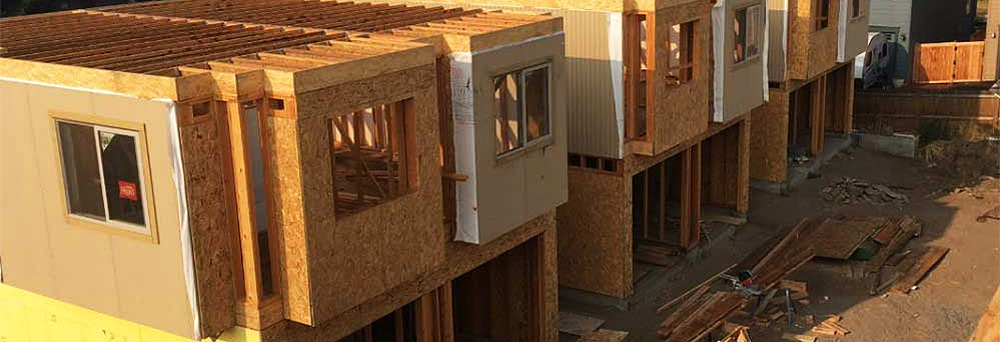
The City offers developer resources in the form of reduced fees, expedited permitting, and tax incentives for deed-restricted, income-qualified units. Additional tools such as flexible zoning rules and access to city-owned land help encourage a variety of housing types while maintaining long-term affordability through deed restrictions.
Developer Incentives for Affordable Housing
As of December 1, 2017, housing developments can apply for an exemption from City of Bend System Development Charges (SDCs) when the property owner agrees to record a deed restriction maintaining affordability for households with income at or below 80% of Area Median Income (AMI). Please note: Bend Parks and Recreation District (BPRD) SDCs must be paid unless the housing development requests a waiver from BPRD.
To qualify, homes must be rented or sold only to people whose income is at or below 80% AMI. These homes must have a deed restriction that keeps them affordable for a minimum of twenty years. The latest income limits based on family size are found on the Bend Housing Hub Housing Affordability page.
How to Apply
Applications are processed through the Online Permit Center Portal. Once logged in, go to the “Public Right of Way, Grading, Agreements & Housing Incentives” section and click “Apply.”
For help with the Online Permit Center Portal, access the Portal Help page. For additional assistance, contact the Housing Division at housing@bendoregon.gov or 541-323-8550.
Required to Upload in CityView at time of Application:
What happens next
If an application is approved, the City staff creates legal documents to record the deed restriction.
SDC exemptions are structured as an agreement tied to a 3% interest repayment provision. As long as the property remains affordable to households earning up to 80% of the Area Median Income (AMI), repayment is not required. However, if affordability requirements are not upheld during the specified period, the full amount, plus interest, must be repaid.
If the property stops meeting affordability requirements during the agreed-upon time, the full amount plus interest must be paid back. However, if the property stays in compliance for the full period, the associated restrictions expire.
Important timing
SDC exemption legal documents must be recorded prior to receiving a Certificate of Occupancy for residential housing.
The City of Bend offers SDC Deferral and SDC Loan options for developments that cannot enter into deed-restricted covenants for affordability. The purpose of the SDC deferral and loan programs is to move the upfront cost of SDCs, typically due before a builder can obtain permits, to a later date. For more information, see SDC Deferrals.
Since 2003, the City of Bend has offered expedited review and permitting to help prioritize the development of deed-restricted affordable homes. Projects that commit to keeping housing affordable for households earning up to 100% AMI may apply for an Expedited Review Letter to streamline the approval process.
How to Apply
Applications for an Expedited Review Letter are made electronically through the Online Permit Center Portal. Once logged in, go to the “Public Right of Way, Grading, Agreements & Housing Incentives” section and click “Apply.”
For help with the Online Permit Center Portal, access the Portal Help page. For additional assistance, contact the Housing Division at housing@bendoregon.gov or 541-323-8550.
Required to Upload in CityView at time of Application:
Review the Expedited Review and Permitting Policy.
Property Tax Exemptions
The City of Bend offers two property tax exemption programs to support housing development.
Program 1: Qualified Rental Housing Tax Exemption
Rental apartment developments that are deed-restricted for households earning 60% or less of the Area Median Income (AMI) may qualify for a 20-year exemption from property taxes—covering both the land and the buildings under Bend’s Municipal Code, section 12.25.
Required to Upload in CityView at time of Application:
- Qualified Rental Housing Tax Exemption Questionnaire & Checklist
- Qualified Rental Housing Tax Exemption Certification of Income Levels
Program 2: Non-Profit Property Tax Exemption
This program also gives a 20-year property tax exemption for deed restricted housing at 60% AMI or less. The two key differences for this exemption is that the applicant must be a not-for-profit organization and the exemption may be applied to all housing types.
Required to Upload in CityView at time of Application:
- Non-Profit Property Tax Exemption Questionnaire & Checklist
- Non-Profit Property Tax Exemption Certification of Income Levels
How to Apply
Applications are processed through the Online Permit Center Portal. Once logged in, go to the “Public Right of Way, Grading, Agreements & Housing Incentives” section and click “Apply.”
For help with the Online Permit Center Portal, access the Portal Help page. For additional assistance, contact the Housing Division at housing@bendoregon.gov or 541-323-8550.
The Tax Increment Assistance for Housing Affordability Program (TIAHA) may provide multi-unit residential rental projects assistance with Bend Urban Renewal Agency (BURA)’s portion of taxes on increased assessed value from structural improvements. Projects must include three or more residential units and at least 15% of units must be rented to households at or below 90% area median income with rental increases below the statutory maximums for the duration of assistance.
How to Apply
Visit the Tax Increment Assistance for Housing Affordability Program page.
Low-Embodied Carbon Housing Program for Space Efficient Housing
The Oregon Department of Environmental Quality, in partnership with the City of Bend, is offering funding through the Low-Embodied Carbon Housing Program.
DEQ received $25.6 million to create the Low-Embodied Carbon Housing Program, as part of Oregon’s Climate Equity and Resilience Through Action (CERTA) grant. DEQ has allotted $4 million of these funds for qualified housing development here in Bend, which could receive up to $20,000 per qualifying unit.
Eligible projects must produce right-sized housing units that do not exceed the program’s square foot threshold as well as meet additional requirements for low-embodied carbon and must have construction completion by March 30, 2029.
Projects producing units which do not exceed the areas specified below:
Single Room Occupancy – 210 sq ft
Studio – 420 sq ft
1-bedroom – 800 sq ft
2-bedrooms – 1,000 sq ft
3-bedrooms – 1,200 sq ft
Projects must reduce embodied carbon of new materials by 10%.
The Program incentivizes lower-embodied carbon housing production, helping Oregon to meet our climate goals while also addressing the need for more affordable housing.
Embodied carbon is the greenhouse gas emissions from resource extraction, manufacture, transport, installation, maintenance, disposal, and recovery of construction materials. Learn more.
Administrative resources
Embodied carbon reduction technical resources
- Video: Introduction to embodied carbon reduction compliance pathways
- Low Embodied Carbon Compliance Guidebook
- DEQ Embodied Carbon Reporting Form
For more information, visit https://tinyurl.com/DEQhousing and contact Kerry Bell with the City of Bend Housing Division at kbell@bendoregon.gov.
Development Code Incentives
The City is working to make it easier and more flexible to build housing. Through updates to development codes and new state laws, there are now more options for creating smaller homes, converting commercial buildings into housing, and building in zones that weren’t previously allowed. Incentives like density bonuses and streamlined application processes help developers include more affordable units. These changes aim to support a wider range of housing types and make homeownership more accessible for people across different income levels.
Developments that include deed-restricted affordable housing may qualify for a density bonus allowing more units than typically permitted in a given zone. Developments that provide 50% affordable units can build up to 1.5 times the base density. The bonus scales down from there—for example, 1.4 times density for 40% affordable units, 1.3 for 30%, and so on.
Affordable housing is defined as:
- Up to 80% of the Area Median Income (AMI) for homeownership units
- Up to 60% AMI for rental units
For full details, see Bend Development Code Section 3.6.250(C), Affordable Housing Strategies.
Cottage Cluster Developments encourage building homes under 1,000 square feet with shared open space. These homes are great for retirees, small families, or individuals. The goal is to make it easier to own a small, detached home in regular neighborhoods, use land more efficiently, and create more livable spaces for residents.
In an effort to lower the overall cost of new housing developments, the City of Bend no longer requires minimum parking standards in any zone citywide.
For more information, see Bend Development Code 3.3.300: Vehicle Parking Standards for On-Site Parking.
House Bill 3450 allows up to 40 cumulative acres of land zoned for employment—Commercial Limited, Commercial General, or Mixed Employment districts—to be developed with standalone residential properties. View a map of eligible sites.
For additional detail, see Bend Development Code 3.8.800: Urben Dwelling Sites.
House Bill 2001 (2019) provides more opportunities for a variety of housing types in traditionally single-family neighborhoods and to increase the overall housing supply in and around cities. The variety of housing types being pursued are middle housing types. HB 2001 defines middle housing as duplexes, triplexes, quadplexes, cottages clusters and townhomes. Often referred to as “missing middle housing,” this style of housing is often missing from our residential neighborhoods, with decades of focus on developing the traditional single-family dwelling or large apartment complexes.
Middle housing often serves as an efficient way to maximize housing units for infill development.
Senate Bill 458 (2021) builds on House Bill (HB) 2001, which legalized middle housing in many cities throughout the state of Oregon. Senate Bill 458 requires cities to allow middle housing developments to be divided into individual lots for more homeownership opportunities.
For example, a triplex could be built on a lot and then split into three smaller parcels, each containing one dwelling unit, by using an expedited land division procedure. The expedited land division process provided an alternative procedure intended to streamline the review of residential land divisions under state law.
Senate Bill 8 (2021) allows the development of affordable housing on lands not zoned for residential uses, and increased the number of units allowed in zones with deed-restricted affordable housing.
House Bill 3395 (2023) allows affordable housing to be built on commercial land, as long as it’s not in an industrial zone. The law also provided flexibility based on income levels and mixed-use options.
For example, housing that is affordable to a household earning 80% to 120% of the area median income can be built on commercial land if commercial use is built on the ground floor of the development.
House Bill 3151 (2023) updates the definition of affordable housing to include manufactured home parks and requires local governments to allow affordable housing on properties owned by housing authorities or non-profits.
The definition of affordable housing included manufactured home parks that serve households earning 120% or less of the area median income. This has the potential for manufactured home parks to be eligible for different zones and higher density standards in line with affordable housing criteria. Zones include residential, commercial, mixed-use districts or public facilities. Land zoned light industrial that is public owned and next to lands zoned for residential use or schools also qualifies.
House Bill 2984 (2023) makes it easier to convert a commercial building into residential housing without doing extra steps in the land use process, such as a zone change or conditional use permit. The bill does not allow this in land zoned for industrial uses or public facilities.
Senate Bill 1537 (2024) adds more flexibility during the application process for developers, including adjustments to development standards and the ability to “opt-in” to new city standards adopted after an application is submitted. For example, if a developer submitted an application for a housing project at a time where 35-foot buildings were not permitted in a certain zone, but then a few months later a City passes new codes to allow for 35-foot buildings in that zone. This bill allowed the developer to opt-in to using the newer codes so the housing project could be built up to 35 feet tall and therefore include more housing units.
Adjustment within this bill will sunset on January 2, 2032.