Tree Preservation for Development
Bend’s Tree Code regulates trees to balance preservation with getting housing on the ground. Use this page to learn more about how trees are regulated when new development is proposed.
How Trees
are Regulated
in Bend
New Development on Sites Over One Acre
The tree preservation standards generally apply to development applications such as Land Divisions, Site Plan Reviews, and Minimum Development Standards Review applications for single-unit dwelling and middle housing developments on properties larger than one acre.
Regulated trees are trees measured at 6 inches DBH (diameter at breast height) or larger.
The standards are intended to protect existing trees during the development process. Additional information about the requirements can be found in the Bend’s Tree Code and New Development section below.
New Development on Sites One Acre or Smaller
Residential Development
For development applications that include one or more dwelling units, micro-units, or single-room occupancies on a site that is one acre or smaller, trees may generally be removed as part of the approved development without being subject to the City’s tree preservation standards.
Land Divisions
The tree preservation standards also do not apply to:
- Residential land division or middle housing land division applications when the original lot or parcel (parent site) is one acre or smaller.
- Land division applications that create lots or parcels that are all larger than one acre, provided the resulting lots or parcels will be subject to the tree preservation standards in the future.
Trees in the Right-of-Way
If you want to remove a tree located in the public right-of-way, such as the area between the sidewalk and street, you must first get approval from the City. Because these trees are located on public property, they are protected and cannot be removed, significantly pruned, or changed without permission. Depending on the situation, a permit, tree replacement, or other mitigation may be required.
Before doing any work on a right-of-way tree, contact the Urban Forester Ian Gray to determine the applicable requirements.
Bend’s Tree Code and New Development
The City’s tree preservation standards apply to certain development applications and establish requirements for tree preservation and mitigation during the development process.
Terms to Know
For the purposes of following the tree code, it is important to understand the following definitions:
Tree Preservation Options
Option 1 | Option 2 | Option 3 |
|---|---|---|
| Preserve at least 20 percent of the Priority Trees (20-inch DBH or larger). | Preserve at least 25 percent of the total DBH of all Regulated Trees (6-inch DBH or larger). | Preserve at least 5 percent of the total DBH of all Regulated Trees, plus provide mitigation. |
Discretionary Track Options
General Discretionary Track
A discretionary track may be requested when practical barriers prevent a development proposal from meeting any of the objective tree preservation options.
Examples include:
- Sites with pre-existing physical constraints.
- Situations where compliance with Development Code requirements or Standards and Specifications would make both tree preservation and development impractical.
If a discretionary track request is approved, mitigation through tree planting, payment in lieu of planting, or another approved method will still be required.
Industrial Zone Discretionary Track
A discretionary track option is also available for properties in the General Industrial (IG) and Light Industrial (IL) zones.
This option recognizes that tree removal may be necessary to create large, level development sites capable of accommodating industrial and commercial uses (excluding small-scale personal and professional services), as well as public and institutional facilities.
Mitigation Options
Tree Replacement
Tree replacement allows developers to plant trees on-site to make up for any amount below the required preservation of 25 percent of the total DBH of all Regulated Trees.
Tree Replacement Ratios
The mitigation required to meet the standard is based on the largest tree or trees proposed for removal that equal or exceed the required DBH. The following are the tree replacement ratios:
-6″ to 9.9” DBH: One Tree
-10″ to 19.9” DBH: Two Trees
-20” DBH or larger: Four Trees
Payment In Lieu of Tree Preservation
Instead of planting all required replacement trees on-site, a payment in lieu of tree preservation may be made for each required replacement tree that is not planted on-site.
A combination of on-site tree replacement and payment in lieu of tree preservation is also allowed.
What Is Happening With Bend’s Newest Tree Code?
In 2024, the City Council passed an updated tree preservation code with the goal to balance tree preservation while still producing needed housing. These codes continue to be regularly reviewed and updated. The City Council will review the tree preservation code with regards to industrial lands in a work session on September 9, 2026.
March 2026 Update: The City approved updates to Bend’s Tree Code focused on tree preservation and replacement requirements. Changes include new exemptions, more flexibility for replacement trees, and additional options for protecting trees during development. More details can be viewed at the link below.
Frequently Asked Questions
Applications for Land Division, Site Plan Review and Minimum Development Standards Review are subject to BDC 3.2.200. Tree removal not associated with a development application is subject to Bend Municipal Code 16.40.
More Info: BDC 3.2.200.A.1An individual tree with a trunk diameter of 6 inches DBH (Diameter at Breast Height = diameter at 4.5’ above ground) or larger. Regulated trees include priority trees.
An individual tree with a trunk diameter of 20 inches DBH or larger.
Trees in poor or very poor health or dead trees are exempt from the tree preservation requirements. Documentation from an ISA certified arborist must be submitted to state whether a tree should be exempt.
More Info: BDC 3.2.200.B.1.bYes, the following applications are exempt from the tree preservation code:
- Applications that include 1 or more dwelling units on sites 1 acre or smaller in size are exempt from the tree preservation code requirements.
- A residential land division or middle housing land division application where the original lot or parcel (parent site) is one acre or smaller.
- A land division application that results in lots or parcels that are all larger than one acre and the resulting lots or parcels will be subject to this section, Tree Preservation, in the future.
- An application where the site has no on-site regulated trees.
The following two situations do not require an applicant to preserve trees to meet the “clear and objective” requirements listed below. However, the applicant still must mitigate – meaning planting new trees and/or paying a fee in lieu – per the mitigation requirements below.
- Land divisions and Site Plan Review applications on sites one acre or smaller
- Sites with three or fewer regulated trees
The “clear and objective” tree preservation standards require:
- At least 20 percent of all priority trees on site to be preserved; OR
- At least 25 percent of the total DBH of all regulated trees on site to be preserved. This would mean if you add up all of the diameters of trees that have a diameter 6 inches or larger on a site, 25% of that number would need to be preserved; OR
- At least 5% of the total DBH of all regulated trees on site to be preserved with mitigation provided in compliance with BDC 3.2.200(E), Mitigation Options. A mitigation option would mean either replanting a certain amount of trees or paying a fee-in-lieu.
A discretionary track review is available if less than 5% of the cumulative DBH is preserved, but the applicant must demonstrate that removal is necessary per one of the listed instances in BDC 3.2.200.C.2. If the discretionary review track is approved, the applicant still needs to meet the mitigation requirements – which means either replanting some amount of trees or paying a fee-in-lieu.
If an applicant keeps a number of trees that is higher than the percentage required in the code, the application is eligible for reduced setbacks, landscape coverage, and lot/parcel dimensions and increased lot coverage.
More Info: BDC 3.2.200.DIf the applicant cannot preserve at least 20% of the priority trees or 25% of the total DBH, or if mitigation is otherwise triggered, the applicant must:
- Plant on-site replacement trees in accordance with BDC 3.2.200.E.1.a., or
- Make a payment in lieu of tree preservation, or
- A combination of onsite replacement trees and an in-lieu payment.
To determine the number of required replacement trees based on the ratios below, use the DBH of the largest tree or trees proposed for removal that will cumulatively equal or exceed the DBH required to meet the 25 percent preservation standard.
- 6-9.9 inches DBH tree removed: one replacement tree.
- 10-19.9 inches DBH tree removed: two replacement trees.
- 20 inches or larger DBH tree removed: four replacement trees.
Keep selecting the next largest tree proposed for removal until the 25% cumulative DBH is met for the total number of required replacement trees.
More Info: BDC 3.2.200.E.1A Tree Inventory Table and Calculations Template has been developed in Excel for you!
For historical information about how the tree code was developed, visit the “Historical Information” section below.
Projects subject to tree preservation review must include the following materials as part of the development application:
- Tree Preservation Site Plan (BDC 3.2.200.B.2) showing:
- Proposed improvements
- Location and identification number for each tree
- Proposed status of each tree (preserved or removed)
- Root protection zones for all trees to be preserved, including any off-site trees with root protection zones extending onto the property
- Proposed tree protection fencing
- Location and species of any proposed replacement trees
- Tree Inventory (BDC 3.2.200.B.1) completed using the City’s Tree Inventory Table and Calculations Template.
- Online Permit Center Portal Data Entry
The information generated from the Tree Inventory Table and Calculations Template must also be entered into the required Online Permit Center Portal fields. City staff will verify that the information entered into the Online Permit Center Portal application matches the submitted worksheet.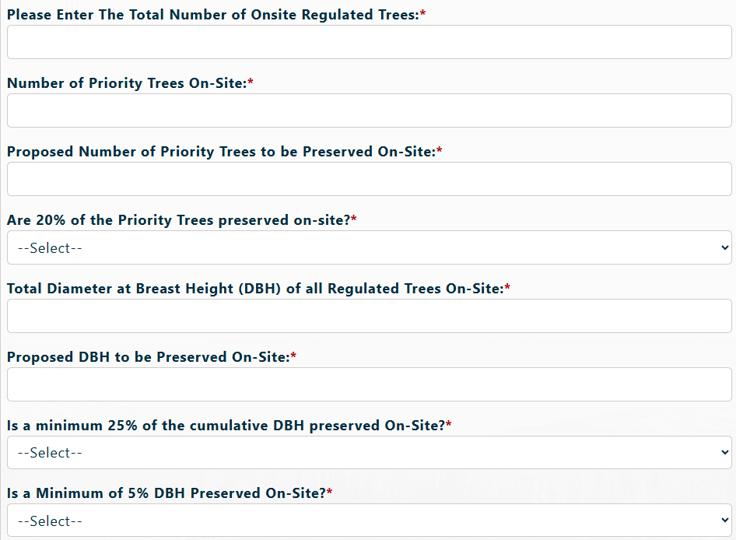
Why is the inventory information required in both the worksheet and the Online Permit Center Portal?
The Tree Inventory Table provides the detailed calculations and supporting documentation needed for project review. The same information must also be entered into Online Permit Center Portal so the City can track tree preservation data consistently across development projects citywide.
Historical Information
In 2024, the Council directed the Tree Regulation Update Advisory Committee to recommend a set of changes to help preserve trees during new development while not serving as a barrier to needed housing.