Estado del proyecto
Fecha estimada de finalización
2029Contacto
Proyecto del puente Reed Market
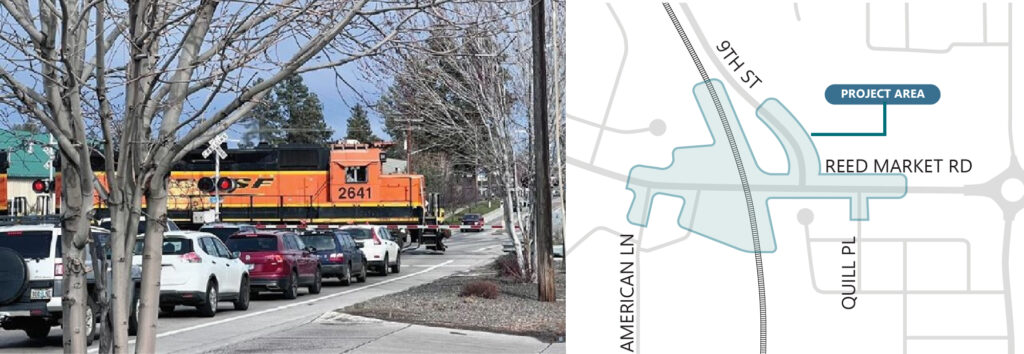
Se están realizando mejoras en el paso elevado ferroviario de Reed Market Road, lo que aumentará la fiabilidad del tiempo de viaje para los peatones, las bicicletas y los vehículos que circulan de este a oeste por Bend. Estas mejoras tienen como objetivo hacer que los desplazamientos sean más eficientes y cómodos para todos.
Un proyecto de bonos GO para transporte de 2020.
¡Gracias, votantes!
Reed Market Road es una arteria vital que atraviesa de este a oeste el sureste de Bend. Es la única carretera al sur de Greenwood Avenue que conecta la calle 27 con la orilla oeste del río. Sin embargo, cada día cruzan la carretera entre seis y ocho trenes, lo que puede provocar atascos de más de veinte minutos.
Se avecinan grandes cambios para eliminar el cruce ferroviario a nivel y sustituirlo por un puente que sitúe Reed Market Road por encima de la vía férrea.
El proyecto ha sido seleccionado para recibir financiación federal y se está llevando a cabo en varias fases; a continuación se muestra el calendario previsto. Como parte de los trabajos preliminares de ingeniería y evaluación medioambiental, el Ayuntamiento llevará a cabo un proceso de análisis de alternativas en el que se revisarán:
- Elementos transversales
- Conectividad de intersecciones, en particular Ninth Street y American Lane.
- Posibilidad de construir pasos subterráneos para peatones y bicicletas en Reed Market Road.
Ubicación
SE Reed Market Road comienza en SE American Lane, cruza las vías del tren, atraviesa SE 9th Street y continúa más allá de SE Quill Place.
Calendario
- Verano de 2024 – Invierno de 2025/26: Ingeniería preliminar y revisión medioambiental.
- Invierno 2025/26 – Invierno 2026/27:Diseño final y adquisición de derechos de paso.
- A mediados de 2027 – 2029Construcción
Financiación
Actualmente, este proyecto se financia durante la fase preliminar de ingeniería y revisión medioambiental mediante una división al 60/40 entre una subvención de la Administración Federal de Ferrocarriles (FRA) y el bono de obligación general (GO) de transporte de 2020, respectivamente.
El resto del diseño y la construcción han recibido una subvención de la FRA por un importe aproximado de 32 millones de dólares. La ciudad prevé firmar un acuerdo de subvención para estos fondos en 2026. La aportación local para la construcción es del 30 % del total de los fondos recibidos y se financiará con elbono de obligación general (GO) de transporte de 2020.
Antecedentes
Las mejoras al cruce ferroviario de Reed Market Road se identificaron previamente en la actualización del Plan del Sistema de Transporte impulsado por la comunidad de la ciudad, llevada a cabo entre 2018 y 2020. El plan fue aprobado por el Ayuntamiento de Bend y los proyectos del mismo se incluyeron en el bono de obligación general (GO) de transporte aprobado por los votantes de Bend en noviembre de 2020. En 2021, este proyecto ocupó un lugar destacado en la clasificación de proyectos realizada por el Comité de Supervisión de Bonos de Transporte.
Documentos del proyecto
Reuniones públicas
- 3 de noviembre de 2025 Jornada informativa de puertas abiertas
El período de comentarios de esta jornada de puertas abiertas ya ha finalizado. Sin embargo, aún puede ver la información sobre la jornada de puertas abiertas. - Diciembre de 2024 Jornada de puertas abiertas previa al diseño n.º 1
El período de comentarios de esta jornada de puertas abiertas ya ha finalizado. Sin embargo, aún puede ver la información sobre la jornada de puertas abiertas.
Preguntas frecuentes
¿Cuánto tiempo durarán las obras?
Una vez que se haya contratado al equipo de contratistas, este elaborará un calendario. El equipo mantendrá informada a la comunidad sobre la duración del proyecto como parte del plan de comunicación.
¿Se cerrará la carretera por completo?
Para construir un puente en el menor tiempo posible y de la forma más segura, es probable que se produzca un cierre total. Una vez que el equipo del contratista se haya incorporado al proyecto, desarrollará sus propios medios y métodos de construcción. El equipo mantendrá informada a la comunidad sobre los cierres y desvíos previstos como parte del plan de comunicación.
¿Cómo será el acceso durante las obras?
¿Qué es el diseño y construcción progresivos y por qué se utiliza en este proyecto?
El diseño y construcción progresivos (PDB) es un método de ejecución de proyectos en el que el diseñador, el constructor y todos los subcontratistas necesarios están sujetos a un único contrato. Este método puede resultar beneficioso en proyectos de gran complejidad, acortar los plazos generales y generar un ahorro de costes. El Ayuntamiento de Bend aprobó este método de contratación el 19 de noviembre de 2025. (Para más información, consulte el documento PDF «Conclusiones»).
¿Por qué un puente y no un túnel?
En el informe de análisis de alternativas se estudió la posibilidad de construir un túnel, pero este plantearía graves problemas de drenaje y su construcción resultaría más costosa debido a la poca profundidad del lecho rocoso. Además, no es posible cerrar la línea ferroviaria durante el tiempo suficiente para excavar con seguridad por debajo de ella. Un paso elevado evita esos riesgos, permite llevar a cabo la construcción con menos interrupciones del servicio ferroviario y reduce los costes de mantenimiento a largo plazo.
¿Por qué no se está ampliando Reed Market Road para añadir más carriles?
Los modelos muestran una mejora en la fluidez del tráfico y la capacidad gracias a las mejoras en la intersección de American Lane y la calle 15. También tenemos previsto ampliar la rotonda de la calle 15 y Reed Market para convertirla en una rotonda de doble carril, lo que aumentará la fluidez y la capacidad en esa intersección. La ampliación completa de Reed Market, que tendría que incluir dos carriles en cada sentido más un carril central de giro para cumplir con las normas de seguridad, afectaría a más de 100 propiedades privadas. Esto hace que este concepto de diseño sea inviable desde el punto de vista de la asequibilidad. En su lugar, la atención se centra en intersecciones clave que incluyen carriles de giro en puntos clave, y los dos carriles ya existentes en dirección este para la mitad de Reed Market entre la 3rd Street y la 15th Street.
¿El proyecto cerrará definitivamente el acceso a Quill Place?
El anteproyecto establece que el acceso desde Quill Place a Reed Market se reservará exclusivamente para casos de emergencia. Una vez que hayamos contratado a un equipo de diseño y construcción progresivo, en el verano de 2026, ofreceremos nuevas oportunidades de participación ciudadana, incluida una reunión en pequeños grupos con el vecindario de Luderman Crossing, y seguiremos estudiando las distintas opciones. Los diseños darán siempre prioridad a la seguridad y al impacto en el tráfico.
¿Qué pendiente tendrá la carretera?
El anteproyecto indica que la pendiente de Reed Market Road es del 6 %, lo que se ajusta a las normas de diseño de la ciudad de Bend.
¿Se puede mantener un camino a nivel del suelo para ciclistas y peatones, de modo que no tengan que cruzar el puente?
No, no se mantendrá el paso a nivel. Uno de los objetivos principales del proyecto es eliminar el paso a nivel para mejorar la seguridad de todos los usuarios.
El túnel peatonal conduce actualmente al barrio de Nottingham, de propiedad privada, que no está abierto al público. ¿Se planteará la posibilidad de crear una conexión accesible al público?
El sendero de acceso público que atraviesa el barrio de Nottingham está gestionado por el Departamento de Parques y Ocio de Bend (BPRD). El túnel peatonal previsto bajo el puente de Reed Market creará una conexión segura entre los tramos existentes del Sendero Histórico del Canal de Oregón Central (CO), que une Reed Market Rd con el Sendero del Río Deschutes, y el sendero que la ciudad tiene previsto construir a lo largo del lado oeste de la calle 9. Además, BPRD tiene un proyecto previsto en su plan integral para ampliar el tramo del Sendero Histórico del Canal de CO que termina en el límite del barrio de Nottingham, más al sur y al este, para conectar con el Parque Alpenglow y las futuras ampliaciones previstas del Sendero Histórico del Canal de CO. Aunque esta ampliación está prevista, BPRD aún no ha obtenido los derechos de propiedad necesarios para permitir el acceso público a través de Nottingham y no puede proporcionar un calendario de cuándo podría suceder esto. Consulte al BPRD para obtener más información.
¿Qué pasaría si no se concediera la subvención federal?
Hemos destinado fondos del presupuesto actual del GO Bond a la construcción del puente de Reed Market, en caso de que no se reciba la financiación de la Administración Federal de Ferrocarriles. En cualquier caso, cumpliremos con el calendario previsto para el diseño y la construcción del puente.
¿Por qué no se construyó el puente en el marco del último proyecto del Corredor Reed Market?
El puente no se incluyó en las mejoras de 2011 debido a limitaciones presupuestarias. El anterior bono de obligación general de 2011 solo contemplaba mejoras en el corredor, entre ellas mejoras en el firme y en la fluidez del tráfico. El último bono de obligación general no incluía un paso elevado ferroviario. Ese fondo de bonos aprobado por los votantes ascendía a 30 millones de dólares e incluía tres rotondas, mejoras en Reed Market y mejoras en la calle 14. El paso elevado de Reed Market es una cuestión de seguridad y movilidad independiente que requiere una estructura mucho mayor y la coordinación con BNSF Railway.